
How Cricket Rain Rules Work: DLS Method, Target Scores, and Overs Reduction
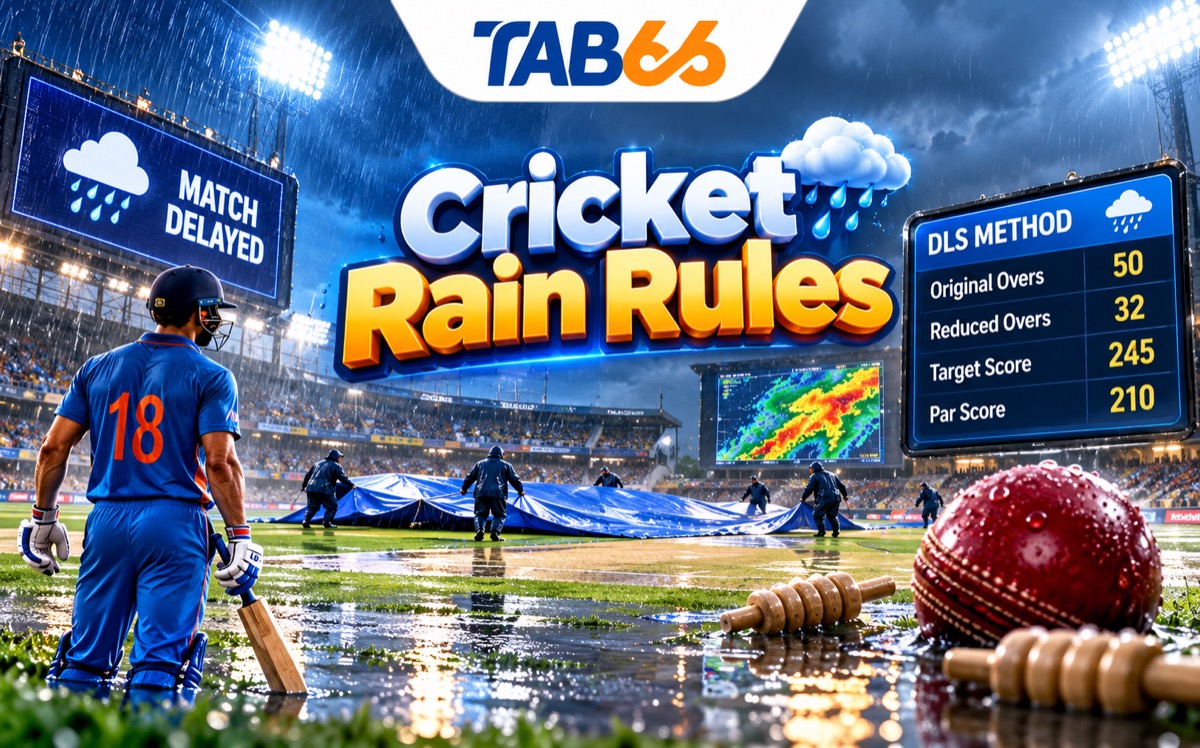
Nothing annoys a cricket fan more than those dark clouds hovering while their side is chasing a low-scoring affair. The covers come on, the players jog off and everyone starts doing some approximate maths. Most of that confusion evaporates when you learn about Cricket Rain Rules Work: the logic behind revised targets is more logical than it appears from the stands.
Here is how to use Cricket Rain Rules Work in practice: the DLS method, revised targets, minimum overs and abandoned games. Written for the fans who want to keep track on rain affected games with confidence, whether it be a domestic fixture from Nepal, an IPL night game or an international ODI. For more cricket content, match explainer enthusiasts can check TAB66.
Why Rain Interruptions Affect Cricket Matches
In cricket the game revolves around two finite resources: overs and wickets, Rain predicts cricket more than most sports. An innings made up of 50 overs and if a side bat first, they utilise all 50 of their available overs to post a score whilst the chasing side has that same amount to chase it down. Since rain can strip overs from one innings but not the other, at least one side is short-changed - fair cricket is neither when that happens, and that is precisely the kind of situation the rain rules in cricket endeavour to correct.
Wet weather affecting ball and pitch conditions. Rain-sodden outfield slows the ball, damp ball is difficult for bowlers to grip and covered pitch becomes lively after a long break. The call on safety has to be made by the umpires, and given how long (an hour-plus often or always) it takes for that decision upon inspection of conditions, interruptions frequently do not come down to a temporary suspension but rather a match called with reduced overs.
What Is the Duckworth-Lewis-Stern (DLS) Method?
The Duckworth-Lewis-Stern method, most often abbreviated to DLS, is the formula used in order to create a level playing field and set reasonable targets in limited-overs matches interrupted by rain. The method was created in the 1990s by two English statisticians, Frank Duckworth and Tony Lewis, and it was adopted by the ICC in 1999. A new person, Australian statistician Steven Stern, took over its maintenance in 2014 and it has since been known by his name.
The central idea is resources. Each innings begins with a team having 100 percent of its batting resources available, which is contingent on the overs left to be bowled and wickets in hand. That percentage declines as overs and wickets fall. This lies at the heart of how Cricket Rain Rules Work operate: DLS takes into account resources available to them, comparing what each side had and translating the delta into an equitable target, meaning whoever bats second is neither punished nor rewarded on weather grounds.
How Revised Targets Are Calculated
This Is How Cricket Rain Rule Works Where Chasing Team Have Lesser Resources Than First Batting Side Par score is determined by taking the first innings total, multiplying it with what proportion of resources the second team has left and dividing that figure by what fraction of resources the first team had. The new target is that par score, rounded down, plus a run. The team getting 80 percent resources have a par total of 224, the total the side chasing the target must get to be level with the current team score that made 280.
The price increases instead if the second team receives more resources than the first team, as one example would be when rain has cut short the first innings. That method adds a defined amount (the average in that format) to the first team's total. That is precisely why sometimes chasing side might end up being set total greater than what the first batting scored.
The scribes note the runs, overs and wickets at that time of cessation, before officials reset the equation on resources still available when new number of overs is calculable. And the new target is shown on the scoreboard and par score of every ball, a number both teams know precisely where they stand.
Minimum Overs Requirements in Limited-Overs Cricket
Minimum overs Cricket Rain Rules Work are actually fairly simple to remember. The minimum is 20 overs per innings in international ODIs, and T20 internationals are played over a 5-over minimum for each team. Any shorter than that and it results in a no-result game, even if some play has taken place prior to the return of the rain.
Cut-off times are also used by match referees and umpires to determine how long a reduced game should be. The match still can finish in a single day, and both teams innings are shortened after the latest start time. A T20 of 20 overs could be changed to a 12-over match, in which the quota for each bowler would stay intact proportionate to the shortened length.
In Test matches, however, a different set of Cricket Rain Rules Work are in operation since DLS cannot be implemented as there is no fixed over threshold for a Test (one team can bat up to more than a single day). Rain is merely elimination of playing time, and where too much has been lost then the match often ends drawn. Captains can call earlier or strike more boldly to bring about a result before the weather claims it.
Abandoned Matches and No-Result Outcomes
Match abandoned is marked when umpires determine that the play cannot start or continue in addition no-result will be recorded when match has not been reached a minimums overs necessary for a result. The two terms are often used interchangeably by fans. A game that is called off prior to a ball being bowled is also classified as a no result, and in most tournaments each team just get half the points.
Knockout games are different, and recent history has made this current situation a fascinating exploration of how our rain rules play out. Many tournaments even schedule a reserve day — so that a semi-final or final can be played if washed-out, but usually only after quite an extended cut-off time is given on the original day. If no outcome can be agreed then the highest-placed side from the group stage progresses or, in some cases, if this precedent has been reached at a final then both finalists share the trophy.
Examples of Rain-Affected Cricket Matches
Perhaps the most famous of these was England versus South Africa in the 1992 World Cup semi-final, which took place in Sydney. The rain had fallen when South Africa required 22 runs in the13 balls still remaining, and the rule at that time was only applied to England. The least productive overs from their innings were exactly removed. That target was amended to 22 runs from a single ball impossible, but the hue and cry spurred cricket towards a just system.
A third classic was lived during the 2003 World Cup, high in Durban when hosts South Africa chased Sri Lanka down after rain played a part. South Africa thought they were ahead of the par score and safely turning a dot ball until the match ended in a draw. It highlighted the importance of checking the live DLS par score after each over, because misreading that one number or a team being less than 20 runs away from said number, can be the difference between second and third place in this round.
The other side of that coin was exposed at the 2019 World Cup in England, where washouts were common. In fact, two of the group games were abandoned without even playing or a ball being kicked and just one point was awarded to each team instead of a win Indeed, rain can define a tournament as much as any batting collapse, which is why mastering Cricket Rain Rules Work helps every fan. If you love moments like this broken down, you can catch more cricket explainers on tab66.com.
FAQs
What is the DLS method in cricket?
DLS – Duckworth-Lewis-Stern method for cricket target calculation in rain affected limited-overs match. That is integral to the operation of Cricket Rain Rules , because it quantifies how much batting each team has available, in terms of overs remaining and wickets in hand, and then turns that into an adjusted target. It has been in use within the ICC international cricket definition since 1999.
How is a revised target calculated after rain?
This is the crux of how Cricket Rain Rules work: officials weigh how many resources are available to each team. Whereas if the first innings score is lower and they are chasing it, the par score is set to the target with one run added on top of this score multiplied by both teams percentages of resources remaining. A team batting second must score more runs than the first team, or they add extras to the total of the first side.
What happens when rain interrupts a T20 match?
Umpires have been waiting for conditions to relented before reducing the overs if play can recommence. A T20 must have a minimum five overs aside to have a result. This DLS method provides a new target for the batting side with a reduced quota of overs to chase it down in direct proportion with bowlers. If five overs are not completed, the match is a no-result.
What is the difference between an abandoned match and a no-result?
A match is declared abandoned when play cannot begin or cannot continue, while a no-result means the minimum overs needed to produce a result were not bowled. If no ball is bowled in a game, it is deemed a no result. In reality, either result mostly ends in the same place: sharing the spoils.
Can a team win a cricket match despite scoring fewer runs than expected?
Yup, and that will shock most first-time rain rule cricket readers. Following rain, the side batting second may be set a revised target in order to win with fewer runs than its opponent. That means that a side that puts up 280 may only target the chasers at 225 in less overs and can reach it on some occasions (with far fewer runs), earning full points for doing so.